
Acid
Brewed coffee is mildly acidic, around pH 5. That's close to where many plant proteins carry little net charge, so nothing stops them sticking to each other.
Plant-based milks · Solulase™
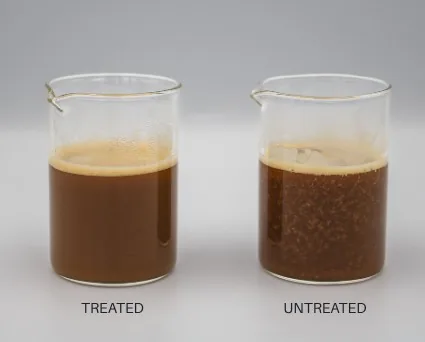
Oat milk splits because hot, acidic coffee pushes oat proteins towards the point where they carry no charge, so they clump. Solulase™ is an enzyme that gives those proteins extra negative charge, so they stay dispersed. In our tests, Solulase-treated oat milk did not curdle in hot coffee and frothed better. It goes into the enzyme step you already run, 1 hour at 50 to 60 °C, and your heat treatment switches it off. There is no new step on the line.
 By Nick Enslin, Chief Commercial Officer · Updated · 7 min read
soluble protein after treatment, from 2.63 to 5.84 mg/mL
in hot coffee, with no curdling, and a better froth
at 50 to 60 °C, inside the enzyme step you already run
of oats treated by one 1 000 U bottle
Process builder
This is a standard oat milk line. Add Solulase™, FiberaseX™ or both at the enzyme step and watch what each one does, and what you get at the end. Every number comes from our own trials, and the source sits next to it.
Your current process. A starch enzyme thins the slurry. Proteins sit close to clumping and the fibre stays intact.
86.1% slurry yield. Okara is set to an index of 100 for your current process.
Risk of splitting. Acid and heat clump the protein, and flecks form on the surface.
No extra process steps. Okara and yield: factory trial, 10 000 L per arm, against a commercial oat enzyme. Coffee and froth: bench tests on oat milk. Mouthfeel: double-blind panel, n = 10.
| Outcome | Current process | + Solulase™ | + FiberaseX™ | Both |
|---|---|---|---|---|
| Coffee stability | Prone to splitting without stabilisers | No curdling in hot coffee | No direct effect | No curdling in hot coffee |
| Froth | Baseline | Better froth | No direct effect | Better froth |
| Mouthfeel | Baseline | Smoother | Creamier body | Smoother and creamier |
| Okara | Baseline | No change | 20% less by weight | 20% less by weight |
| Oat solids kept | Baseline | No change | 113 kg more per 10 000 L | 113 kg more per 10 000 L |
| Slurry yield | 86.1% | No change | 88.0%, +185 L per 10 000 L | 88.0%, +185 L per 10 000 L |
| Sugar profile | Set by your starch enzyme | No change | GX glucose-led or MX maltose-led | GX or MX |
| Decanting time | Baseline | No change | No change | No change |
| Extra process steps | None | None | None, replaces your starch enzyme | None |
The problem
Three things happen at once when cold oat milk meets a hot cup. Each one on its own nudges proteins together. Together, they're enough to split a drink that looked perfect in the carton.
Brewed coffee is mildly acidic, around pH 5. That's close to where many plant proteins carry little net charge, so nothing stops them sticking to each other.
Coffee is served hot. Heat loosens the folded shape of the protein and exposes sticky patches, so clumps form faster than they would cold.
Calcium and magnesium from hard water and from the coffee itself act as bridges between proteins, pulling them into the flecks you see on the surface.
Most barista oat drinks fight this with acidity regulators such as dipotassium phosphate, plus oil for body. Those change the conditions around the protein. Solulase changes the protein itself, so it holds up in the cup on its own terms.
The mechanism
Solulase is a recombinant glutaminase that deamidates plant protein. Oat protein, like most plant proteins, carries plenty of glutamine, which is exactly what the enzyme works on.
It converts glutamine to glutamic acid where it sits on the protein chain. No peptide bonds are cut, so the protein stays whole and no bitter peptides form.
Every conversion adds a negative charge. The protein's clumping point moves down and away from coffee's pH, and it stays dissolved.
A more charged, more open protein holds oil droplets and air bubbles better, which is why emulsions stay steadier and the froth builds better.
It works during the enzyme step, is inactivated by your heat treatment, and isn't intended to be active in the finished drink.
In your process
Solulase goes into the step you already run. Here's the sequence we use on our own oat protocol and in customer trials.
Mix oat flour and water at your normal ratio, with your usual equipment.
Solulase is most active around pH 5.5. Measure your slurry before the first trial. If you run well above that, tell us, and we'll set the dose with you.
Start at one 1 000 U bottle per 360 kg of oats. Our own oat protocol uses 6 bottles per 2 000 kg. Always dose against the oat weight, never the water or the litres of finished milk.
Solulase goes into the same tank at the start of the enzyme step, alongside your starch enzyme or FiberaseX™.
One hour is standard. If your process already runs up to 2 hours, that's fine too.
Decant, heat treat, formulate, homogenise and fill. The heat treatment inactivates Solulase.
Use the coffees your customers actually drink, at café temperature, made with local water. Run an untreated control alongside.
Specification
Questions
Hot, acidic coffee (around pH 5) pushes oat proteins towards the point where they carry little net charge. Heat unfolds them and calcium and magnesium bridge them together, so they clump into visible flecks.
It tackles the same problem from a different angle, by making the protein itself more soluble. Whether you can reduce or remove your acidity regulator depends on your base, your oil and your target coffees. We recommend a three-arm trial: your current recipe, your recipe plus Solulase, and Solulase with a reduced regulator dose.
In a double-blind sensory panel (n = 10), Solulase-treated samples scored smoother in mouthfeel. Because it doesn't cut peptide bonds, it doesn't create the bitter peptides that protease treatments can.
Solulase is used as a processing aid: it works during processing and is inactivated by the heat treatment. Labelling rules for processing aids differ between markets, so confirm with your regulatory team. We supply the documents they need to decide.
Solulase is produced by fermentation using a genetically modified E. coli strain, BL21(DE3). The enzyme is purified, and residual recombinant DNA tests below 1 ng/g by PCR in both the product and the finished milk.
Yes. They work on different things: Solulase on protein, FiberaseX on starch and fibre. Both go into the same tank, the same incubation and the same heat step. Each enzyme's results on this page come from its own trials.
Yes. Solulase is Kosher certified by the Beth Din and Halaal certified by SANHA. Solulase production is covered by our ISO 22000:2018 certificate (no. 987).
Oat, macadamia, cashew, soy and almond. Dose follows how much glutamine the protein carries: one bottle treats about 360 kg of oats, 300 kg of macadamia, 150 kg of cashew, 135 kg of soy or 115 kg of almond.
It's priced per bottle, with volume tiers. Send us your annual volume and we'll give you a cost per litre of finished drink.
Tell us your base, your batch size and what you're trying to fix. We'll send trial bottles with a dosing plan and help you set up the trial arms.

Trial kit
Tell us what you're making. We'll send Solulase, a dosing plan built around your batch, and a scientist who'll help you read the results.
Keep reading